
My Writing Process Series
- Part 1: Intro
- Part 2: Tools of the Trade
- Part 3: Taking Notes
- Part 4: Plotting
- Part 5: The First Draft
- Part 6: Editing…or the Second Draft
- Part 7: Editing…Part 2
- Part 8: Formatting
- Part 9: Cover Design
- Part 10: Publishing (part 1) ← You Are Here
Howdy Freeholders!
It’s time for the next to last installment in my Writing Series of Blog Posts, all about Indie Publishing. This may not be your cup of tea if you’re happy being a reader, but if you’ve ever wanted to see your words in print and have a go at making a living (or just coffee money) at writing, keep scrolling down to see how I do it. This post also isn’t going to be a detailed step by step instruction manual on how to publish, but a quick overview of my process for the curious. Reminder: the words you’re about to read are by no means the end-all-be-all of how to indie publish, just how I publish. As with anything in life, your mileage may vary.
How to skip the gatekeeper
Traditional publishing is great, we wouldn’t have the great books of literary history without the trad pub industry…but it’s not for everyone. In these modern times where market strategies and conditions change on the latest trend or celebrity gaffe, the ability to change content of a book and publish within hours cannot be overvalued. A traditionally published author would be lucky to get a single book published in one calendar year. The most I’ve published as an indie author in one 12 month period is 6. And I wrote 8 in that period, but the last two ended up coming out the next year.
Leaving the speed factor alone for a moment, the other main tactical advantage of indie publishing is we get to skip the gatekeeper. Who’s that? Well, in trad pub circles, it could be the editor of a publishing company (or one of their associates, or a committee…you get the idea). The gatekeeper is the one (or people) who decide what’s getting published that year, what will be popular (by dint of being published vs another idea that was rejected) and what they will accept for publication and what they will reject. If you don’t make it past the gatekeeper, you’re not getting published, end of story.
As an indie author, there is no gatekeeper. If I want to publish a zombie book (ahem…Elixr Plague), then I damn well will publish that book. If I don’t, I don’t. If I decide a book has too many errors in it, I can change it and upload the correct files in a matter of minutes or hours, if I have multiple distributors to reach. A correction at a trad pub company will take months —they have to review it, approve it, send it to the printers, get the copies, review the copies, send them to the book stores, etc…that all takes weeks and months, and is very expensive to boot. The result? Hardly any corrections or changes re made to trad pub books unless the first printing run is a success and they order a second edition —which is the perfect time to make any changes. That could take months or years.
I have a book file…now what?
If you’ve been following along and read my post on formatting a book file in Vellum, then you know you’re ready to publish with any of the big players in the indie world: Amazon, Apple, Kobo, Google, Barnes and Noble, and last but certainly not least, Draft 2 Digital (D2D).
Exclusive or Wide?
The question is do you want to publish with all of them, some of them, or just one of them? If you’re going to go with one, most people pick Amazon. It’s the biggest distributor out there and has the largest market share of readers. Some people don’t like Amazon for one reason or another and choose to go exclusive with Apple…or Google…or…you get the idea.
I prefer the shotgun approach. Why leave potential readers out in the dark? I publish everywhere I can for all my books, except for Elixr Plague, which, as a shorter, more serialized story, is far easier to keep on one platform (Kindle Unlimited) than it is to publish everywhere. Also, the books co-written with Mike Kraus are available exclusively through Amazon.[1] But all my other books (all 20+ of them) I publish with Amazon, Apple, Google, Kobo, and Draft2Digital—which also nets me Barnes and Noble and dozens of international booksellers, and the library system.
We’ll begin with the 900 pound sloth in the room. I always start here, not just they’re the biggest game in town, but because they’re the slowest when it comes to the publishing process, so I start things off here, and move on to the others while Amazon is thinking, killing two birds with one stone.
Amazon: Kindle Direct Publishing

Amazon’s Kindle Direct Publishing is the place to be to sell your book on Amazon.
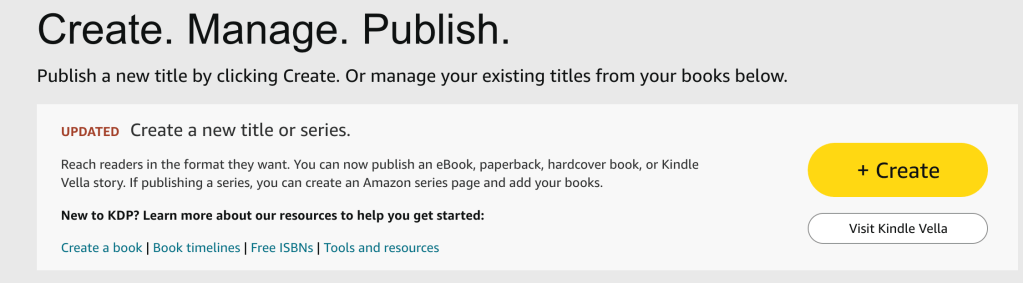
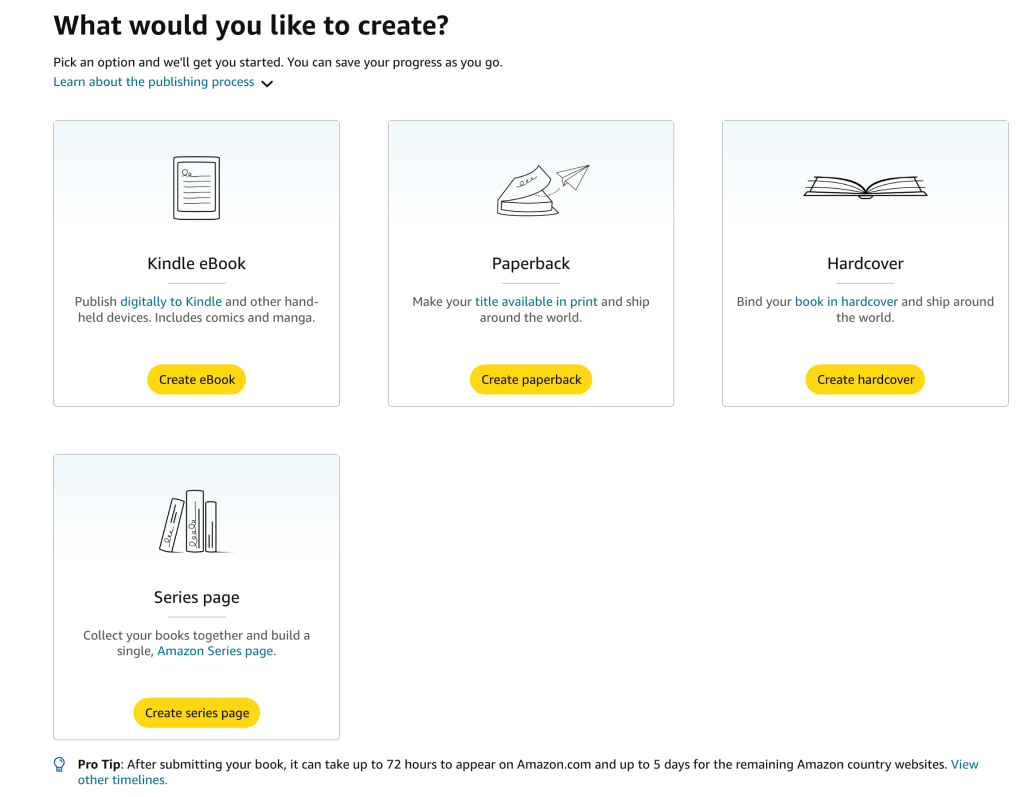
You start (after creating an account) by choosing to create an ebook, a paperback, a hardcover, or a series page. It’s like a choose your own adventure in publsihging.
Make your choice, and then it’s on to the questions. In the following pages, you’ll upload your book file and answer a series of questions spread out over several pages about the work: what’s the title, and/or what’s the subtitle? Is it part of a series? If so, what volume number…etc., etc.
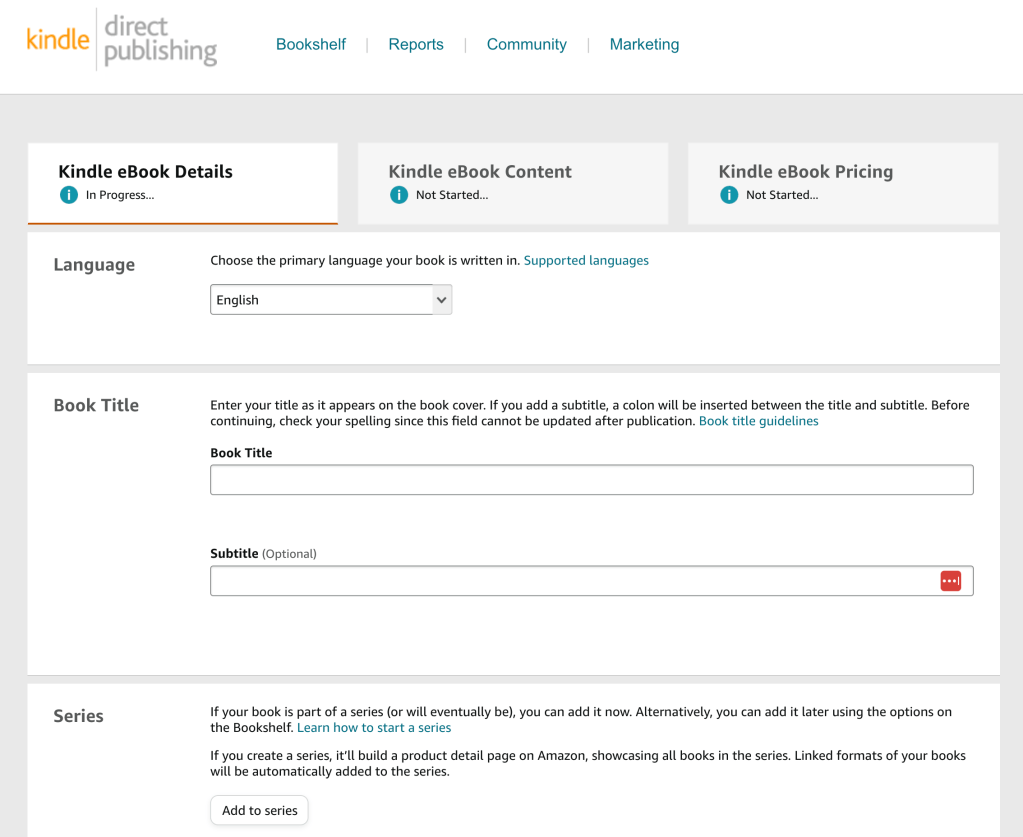
You’ll fill everything in and click through to the next page, and so on, answering questions about AI content (you did write your book yourself, didn’t you?) and the latest book and cover files, the publisher imprint, and any age restrictions or content restrictions (like explicit language, violence, or sexual content). Each step of the way the system pauses for a moment to analyze your inputs and save.
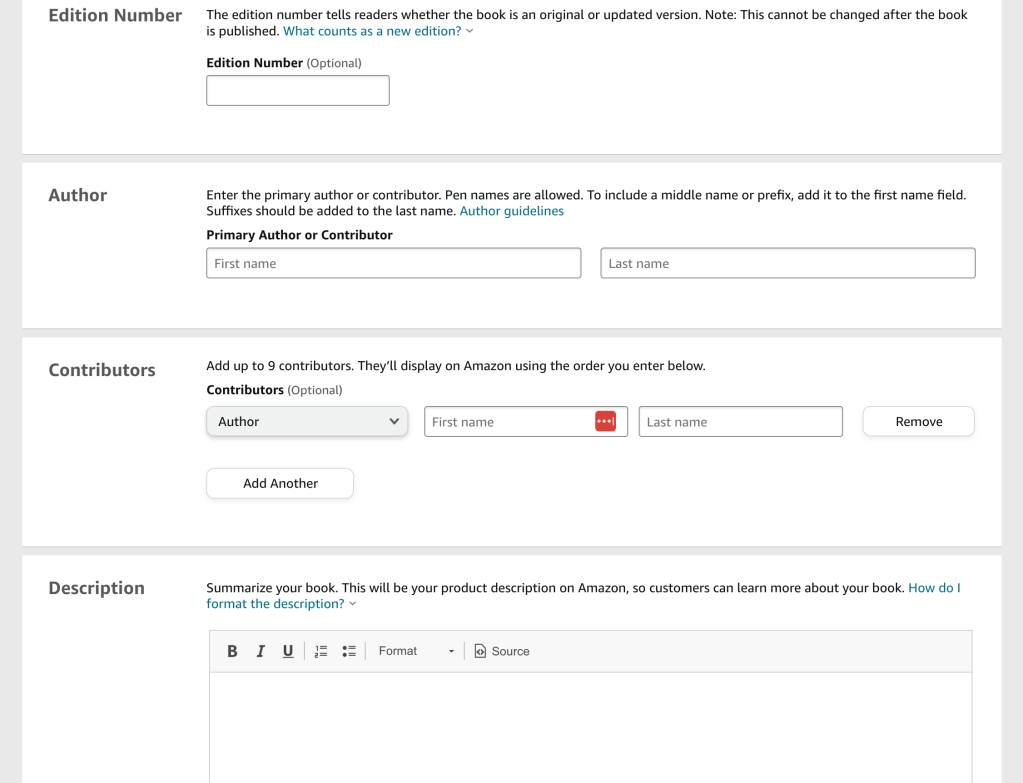
It’s all rather self-explanatory as you go along. It’s not difficult at all. But, each time you move to the next page, it takes a little longer to save. Eventually, you make it to the page where you set your price and click finish…then you wait for a minute (or longer) while Amazon massages the data and eventually the algorithm decides if you can publish or not.
In the 40+ books I’ve written, not one was rejected. Once again, your mileage may vary.
Once you’ve submitted your book, in about 12 to 72 hours, Amazon will actually approve and publish it. That’s called “going live.” I’ve found for the other distributors (Google, Apple, Draft2Digital, Kobo, in no particular order) the process takes much less time from start to finish, but then again, Amazon brings in the most money.
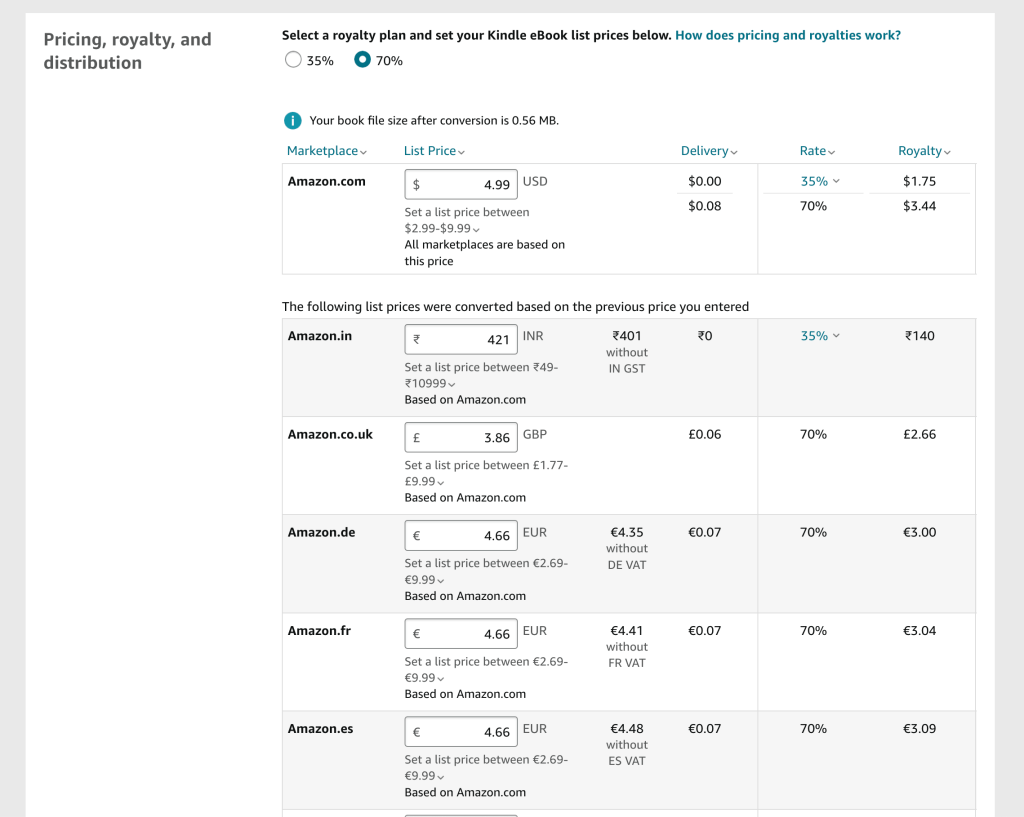
Speaking of money, you can expect to take home roughly 70% royalties (meaning for every dollar you earn selling a book, you keep 70 cents and Amazon keeps 30 cents plus an $.08 charge for delivery of the ebook…’cause, you know, Amazon has to pay the electric bill) for a book priced higher than $2.99. If you make your book $.99 or free or anything under $2.99, Amazon only pay’s 35% royalties…but there’s no delivery charge, so you got that going for you.
There’s even a nifty page in the submission process where you enter a price and Amazon adjusts if for world markets (all the big players do this) so you can see at a glance what you’ll be charging, say, in Canada, France, Mexico, Australia, and the UK vs the US. Most of the other big name players all follow this scheme (more or less).
Next time, I’ll briefly dive into what the submssion process is for publishing wide to Apple, Google, Kobo, and Draft2Digital.
Until then, keep your heads down and your powder dry, my friends—we live in interesting times.
Notes
[1]: 18 books over three series: Broken Tide, Lost Sanctuary, and Ravaged Dawn.
 The Freeholder Press
Leave a comment