
Howdy freeholders!
Last time I talked about my observations working in a retail environment before a hurricane hit. In this post, I’ll go over my observations working in a different retail store, this time in Texas, when a major ice storm rolled through the area. [1]
I don’t know if you know anything about Texas, but they’re not exactly known for harsh winters. In fact, other than a few areas in the Panhandle, most of Texas doesn’t see all that much snow at all. What they do see a fair amount of his ice. Now keep in mind, for the rest of this post, my wife and I had moved from Florida to Texas, both of us were in our 20s. We had no kids at the time, though Texas is where two of our three kids were born.
At the time of this storm, I was working as an assistant manager at a major big box arts and crafts store. Who you ask? Well, there’s only two really big national arts and crafts retailers, and one is closed on Sunday. I worked for the other one.
I worked at several stores over the course of my career in the Dallas-Fort Worth area, from Arlington to Keller. One winter, we were given advance warning of a storm that could potentially drop some snow on the area. Everyone was fairly excited, because snow isn’t all that common in that area of Texas.
In the six years we lived there, I can count the number of snowstorms we had on one hand.
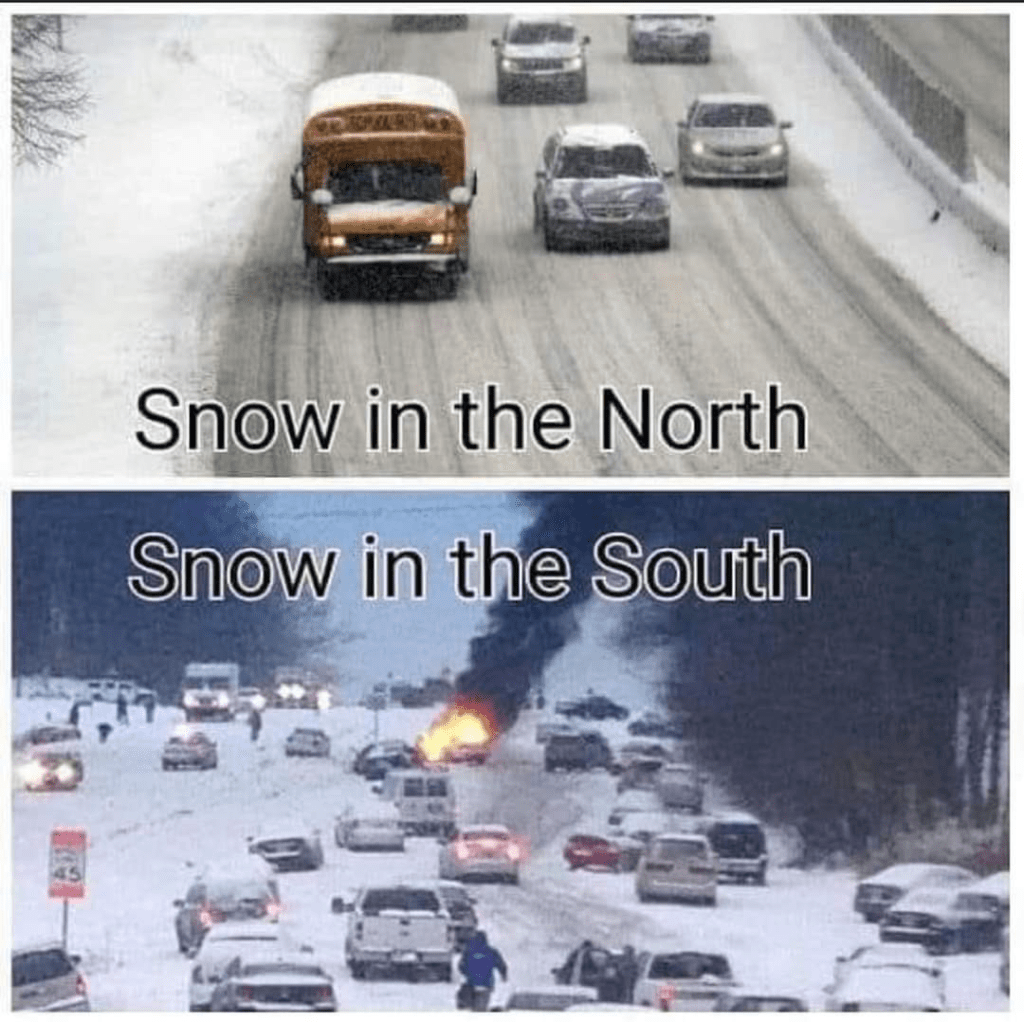
What caused more excitement, however was not the fact that an inch or two of snow was predicted, but also that an inch of ice was predicted. Now, at the time, Texas wasn’t a big fan of using salt. Up north, here in Illinois, everybody uses salt. But Texas has much hotter summers, and to make the roads tolerant of that hellish heat, they have to use a type of concrete and asphalt that does not handle salt very well and is quickly destroyed. So, like much of the South, they use sand instead.
Spending as much time as I have in the north, living in Delaware and Illinois, and later Wisconsin, I can tell you that salt works a lot better at actually melting ice and snow. Sand will give you a little temporary traction—until your tires grind the sand down into the snow—but it won’t do squat to actually make conditions better.
So, I was already on my guard for this storm. The temperature seemed to be about right for a major ice event, barely around freezing, dipping slightly below. But the air temperature wasn’t cold enough for snow. In the end, we ended up getting a little snow, but most of it was ice. More than what they expected. That made for a hot mess in our store parking lot, roads were a treacherous hazard just getting to and from work, and many stores and restaurants closed. Most school systems shut down, as did the government, and Keller quickly became a ghost town.
But did our store close? Oh no. We weren’t given permission from corporate to shut down, though we were the only one open in our shopping center. Did that stop customers from coming? Well, corporate must’ve known something, because we still had customers. In my mind, there weren’t nearly enough customers to warrant keeping the building open and paying all of us to stay there, but what I did know, I just ran the place.
As happened when I worked at Sheets and Shit, when people came wandering in the store to browse for random, nonessential items just hours before a hurricane hit, as the snow and the sleet and ice was currently falling outside, people came in looking for scrapbooking supplies. Now, I understand having creature comfort items for when you’re expecting to be snowed in during a power outage, but going out to buy stuff to keep you busy with your scrapbooking hobby would not be the first thing on my list of things to do when the storm was actually there.
But, I kid you not, we actually had an argument break out between two women who wanted the same scrapbooking tool. We didn’t have any more in stock, and they almost came to blows over this pair of fancy scissors that came with a cool hole punch.
They were paying (sometimes) customers, so we had to help them. We had to stand there at the cash registers grinding her teeth waiting for them to hurry up and get out so that we could close the store and go home. As we watched the snow and ice build up, me and the other managers glanced at each other shaking our heads, knowing that with every minute we stood around waiting for these people to make their sticker selections, it was another minute that the roads would be just slightly more treacherous for us to pick up our kids or get back to the safety of our own homes.
It was maddening.
But like when the hurricane hit, I learned some valuable things.
Takeaways
Firstly, creature comforts are not to be underestimated. As it turned out, everything was shut down for a couple days after that I storm. The roads were too dangerous to go out driving around—just to go shopping—and a lot of people had to make do with whatever they had on hand. Once again, my wife and I were pretty well set with canned foods and enough ready to consume food items that we weren’t in danger of starving because we couldn’t leave the house.
In fact, I made my hurricane nachos for dinner one night, and we had ourselves a relaxing evening watching the antics of people who didn’t have enough sense to stay inside during the ice storm, all while eating the dish I created during the 2004 hurricane season when we’d just cobbled together things out of the pantry to make a surprise dinner (hence hurricane nachos…look in the notes for the recipe if you want it).
It was also my first experience in dealing with a state that didn’t have salt and didn’t use salt. It meant that at the store, I had to go out and reapply sand almost on an hourly basis as it got covered up by fresh snow and ice, and scattered by people coming in and out of the store. At least if I had had salt, it would’ve melted the ice on the sidewalk and we wouldn’t have had such a big mess hours later. Side note, trying to scrape snow and ice off the sidewalk with a regular garden shovel is not fun.
I think what surprised me both most was the attitudes of the people who came into the store. They didn’t seem to notice or care about the storm raging outside in the snow and ice coming down so hard that you can hardly see across the parking lot. They certainly didn’t care that all the employees who’d been at work during the day had the dubious task of going outside and cleaning off all the ice from their cars before they could even think about getting home.
Only when the lights started flickering, did the customers look up and think, huh, maybe I shouldn’t be out, maybe I should get myself back back home.
No, most of them didn’t even notice the power in the store struggling toward the end of the storm, and the ones that did glance up with a questioning look on their faces shrugged and went back to browsing the scrapbooking supplies.
It was a surreal experience. Lights flickering, snow and ice building up outside, most of the world already disappeared, and the entire mall looking like a ghost town…and these people were digging through the deal of the week section on stickers and ribbon.
I’ll never understand how it’s even possible for people to go through life at that pro level of obliviousness.
Luckily, there wasn’t much preparation for me to do at the house for a storm like this. The area we lived in was flat, so I didn’t have to worry about hills. We had a long driveway and that made it a little treacherous getting to the house, considering we had a ditch on either side, but it was easy enough to scrape clear with the tools I had on hand.
When ice storms hit, I simply covered the driveway in sand so we could get our vehicles in the garage. Other than having enough food and water on hand to survive a blackout—which eventually happened, plunging our neighborhood, and most of the little town we lived in in the darkness for about eight hours—we were pretty well set.
There wasn’t a big threat to our windows, the house was well insulated, and we had a wood burning fireplace, so when the power did go out we were able to stay warm, at least in the living room. However, now that I’ve lived in Illinois and Wisconsin for the last decade, I know that the cold we experienced that day in Texas is not really cold at all, and was kind of like spring weather up here.
At the time, though, it felt like we were on an Arctic expedition in the 1920s, without computers, cell phones, or any other kind of modern convenience, sitting in the dark reading books by firelight, eating cobbled together dinners made out of emergency supplies.
Hopefully, with the recent crazy weather and massive snowfalls in the deep South, there’s not too many people that have to scramble to get food. With that said, you never know. Maybe by writing blog posts like this, someone will take a moment to think and update their preps, or at least consider being prepared.
If I’ve reached at least one person, then it’s all worthwhile.
So until next time, my friends, keep your heads down your powder dry, for we live in interesting times.
Notes
[1]: Major is relative here. I now live in Illinois, and that “major” ice storm I dealt with in Texas would literally be laughable here.
Marcus Richardson’s Hurricane Nachos
- ground beef, cooked (we had about a pound on hand)
- 1 can of baked beans (any brand will do, any flavor)
- lettuce
- shredded cheese
- sour cream
- tortilla chips
Cook the beef and drain. Pre-heat oven to 350º. Heat up the beans in a saucepan. Split the cheese so you reserve a little for the topping at the end. Put tin foil on a round pizza baking dish (what I had on hand) and put a layer of chips down. Scoop some baked beans onto the chips, then some beef. Add cheese, then a layer of chips, and repeat until all the beans and beef are gone. put the remaining cheese on top and put the whole mountain of madness in the oven for a good 10 minutes, until the cheese is as melted (or crispy) as you like.
Remove from the oven to cool for a couple minutes, then top with lettuce and sour cream. Use a big mixing spoon to cut it like a cake and put on a plate and enjoy!
 The Freeholder Press
Leave a comment