
Howdy Freeholders!
This week’s edition of the Update will be a little different. I originally wrote the following post almost ten years ago in January of 2016. It’s just as appropriate today, since I get asked why and how I became a dictation writer —here’s the answer and the exact moment (January 8, 2016). If you’ve heard me…uh, seen me? Read me? — go on about how awesome it is to dictate a book instead of sitting down and typing, this post explains the Eureka moment when I did an experiment and confirmed what I suspected: dictating is WAY faster than typing. So here goes…
It’s kind of a big deal…really.
First, I want to let y’all know how excited I am. See, last week, Mrs. Richardson took the kiddos down to visit family and friends in her home town and I was left to my own devices (and the dog). Normally, that would be a pretty depressing idea (the dog doesn’t say much and has to be walked…and it was COLD around these parts) but I used the time to write. And write I did.
Over the course of 72 hours, I cranked out something like 64,000 words. To put that in perspective, November is National Novel Writing Month (you may have seen me refer to it in these hallowed pages as NANOWRIMO) and every year thousands of writers and aspiring writers gather on the internet to write. During the 30 day contest, the goal is to write a 50,000 word novel in 30 days.
I wrote 64,000 in just under 4 days.
How you ask? Dragon Dictation.
I know, I sound like a freaking advertisement for Nuance, but I’m telling you, I get no financial compensation from them whatsoever. I just really, really, love Dragon. I hadn’t dictated for a while thanks to the holidays (there were simply too many little ears around to hear me describe fight scenes and vulgarity…so I reverted back to typing) but when I was free to ride my dragon once more, look out! I did a little experiment the first 36 hours and looked at my outline as I dictated.
My outline consisted of the following:
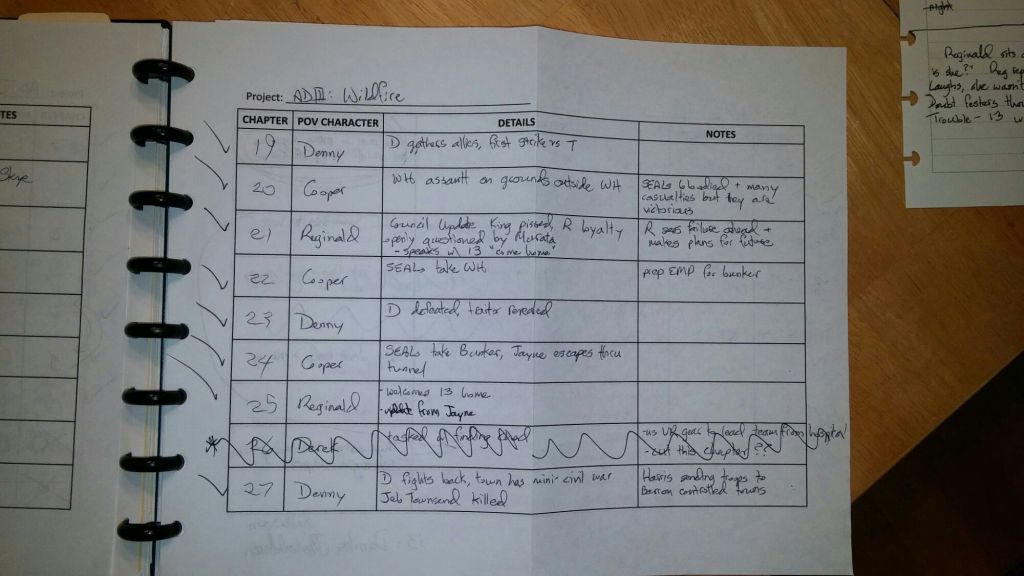
Just a few sentences really. Who’s the main POV, what happens, and are there any specifics that need to be mentioned or what was the resolution? [1]
Looking at this, I muddled my way through the chapter on the fly. This is called “pantsing” (short for writing by the seat of your pants…some more refined authors, like Stephen King—you may have heard of him—call this “discovery writing” because you discover what the hell is going to happen at the same time as you write it…it makes for a fun writing session, but can be a bit stressful because you don’t know where you’re going until you get there). I wrote all of Alea Jacta Est and most Apache Dawn this way, so it was like slipping on a pair of old, comfortable jeans.
Then, I decided to try the alternate method for the next 36 hours of my writing retreat.[2] Instead of pantsing/discovery writing, I’d try plotting.
Plotting is the opposite of writing by the seat of your pants, and involves anything from fleshing out a few sentences of the chapter to writing an outline as an almost complete chapter/book, detailing everything done and said (like writing the damn chapter itself) before writing said chapter/book.
So, I sat down with my modern quill and wrote out a few paragraphs of what I foresaw happening to certain characters in that chapter. Who did what…and then what happens? This method left me free to make up details on the fly and change things, all with the secure knowledge that I had already figured out who fights, who lives, who dies, etc…in that particular chapter.
If there was a particular conversation I wanted to take place, I put that in there so that as I walked around the house (or on the treadmill) confusing the hell out of the dog as I talked to myself for hours on end, I knew exactly where I was going, if not exactly how I would get there. Here’s what it looked like with a 2 section chapter:

Aside from confusing the dog by talking to myself, the plotting method easily won me over. With a clear road map of sorts in my hand, I felt free to roam, knowing I could find my way back to the story. That, coupled with the detailed idea of what I wanted accomplished in the chapter led me to write a lot faster.
Results
The results? The first 36 hour stretch (pantsing) netted me something around 19,000 words. A pretty respectable sum by any standard, I think. Considering, I didn’t write for 8 hours straight. I wrote an hour here, an hour there, in between doing laundry and putting the house back together after the holidays, walking the dog, sleeping and reading, etc.
The next 36 hour shift, I wrote using the plotting method (or my half-breed attempt at it) and brought in around 45,000 words. That is a huge increase in production. I wasn’t keeping track at the time and went back after it was all said and done…you could have picked my jaw up off the floor. I knew it was a pretty big difference—I seemed to move through chapters faster and felt more accomplished at the end of each writing session—but I had no idea it was that big a difference until I tallied everything up.
64,000 words in a little over 3 days or so. If I wasn’t hooked on dictating, I sure as hell am now. That and honeyed tea. Ye gods, my throat got sore over those days!
Why am I so excited over word counts? Aren’t books measured in pages, you ask? Well, partly it’s an author thing. But here’s another perspective: most of my books in the Wildfire series clock in around 120,000–150,000 words (which yields about 250–300 pages, depending on how it’s published, print/digital).
We’ll leave aside for the moment the doorstoppers in the Future History of America series—they’re more like 220,000–240,000 words each.
What’s the average novel you say? For the most part, it’s a sliding scale, but technically it’s historically been anywhere between 40,000 words and up. In the United States, right now, the average book is about 70,000–80,000 words.
A novella is anywhere between about 20,000 and 40,000 words, while anything under 20,000 can safely be labeled a short story (or serial segment) by most people. Again, it’s a sliding scale that is highly subjective, so one person’s 50,000 novel may be another’s novella.
Out of habit and because I enjoy doorstop books immensely—looking at you Tom Clancy, Robert Jordan, and George R.R. Martin—I tend to write longer. A novella to me could be 90,000 words on the low side. It depends, honestly, on what the author—and more importantly, the reader—wants it to be.
At any rate, this rather long-winded explanation (see, I told you I write a lot of words) is just to explain to you where the 64,000 words I wrote fits in the greater scale of the world of fiction. I ended up writing a decent sized novel—though for me and my readers, it will only turn out to be about half of the average book in the Wildfire series.
What does this mean for you? It means I can bump up my production schedule. That means you get to see what happens next in the flu-infested world of Wildfire that much sooner! It means you get to see Reginald and the Council get their comeuppance…or do you? That means I get to jump back into the Future History of America series and see what happens to Erik and Ted and Brin on their long-awaited journey north…It means I get to come up with another Latin name for the 3rd book in that series…[3]
Well, you get the idea.
And that is how I made the switch from typing to dictating, and never looked back. In the eight years since I made the above post, I’ve followed the same method and written 15 of my own books, a few short stories, 2 novellas, and 18 books co-authored with Mike Kraus. Not bad, considering most traditionally published authors average one book every couple years or so!
As always my friends, keep your heads down and your powder dry, because we live in interesting times.
Notes
[1] You can read a more detailed account of how I plot and outline here. [link]
[2] I used to laugh at the idea of a writing retreat…really? Writing is such hard work you have to escape for a weekend/week—whatever—to…type? Now that I’ve experienced the unbridled freedom to write whenever, whatever you want—free from interruption—for days on end…it’s nirvana, man.
[3] The name ended up being Dux Bellorum (war leader).
 The Freeholder Press
Leave a comment