
My Writing Process Series
- Part 1: Intro
- Part 2: Tools of the Trade
- Part 3: Taking Notes
- Part 4: Plotting
- Part 5: The First Draft <— This Week
Howdy Freeholders,
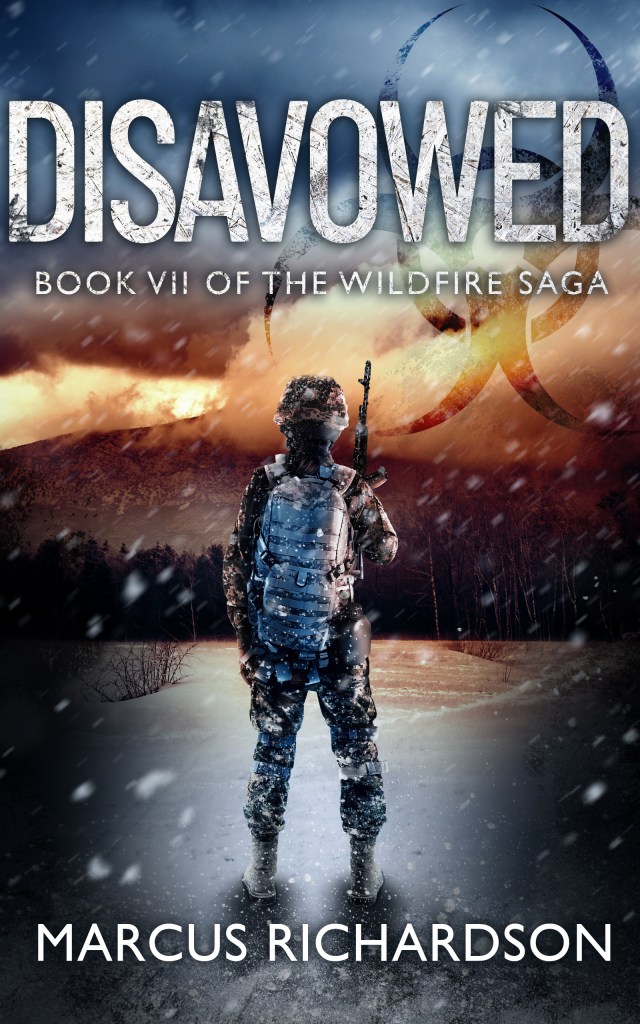
Just a quick reminder before I launch into the blog post: you’ll want to get your copy of Disavowed soon! The $.99 price won’t last forever. In fact, it’s going to regular price $4.99 tomorrow (28 September 2024). Get the latest installment of the Wildfire Saga for the lowest price it’ll ever be!
Okay, now, on with the blog…
Time for the latest edition of my series of posts on how I write.
My Writing Process Part 5: The First Draft

I’ve listened to a lot of advice about writing over the years and a few bits have stuck with me. First is Hemmingway’s classic axiom: Write drunk, edit sober. I won’t say I’ve ever written while truly drunk, but I have enjoyed a beer or whiskey (or two) while writing. That said, I have taken his advice to heart about editing sober, and never touched a drop of alcohol while doing that critical work. My mind has to be sharp and I have to have control of all my faculties to deal with editing.
The other piece of advice I gleaned from my readings and experience has been to just get everything out in the first draft, don’t worry about what it looks like, let that word vomit flow, and purge your mind. There’s a reason why some people call the first draft the rough draft. It’s rough, it’s messy, there are misspellings aplenty to trip over, you can fall down plot holes, and there may even be missing characters (or mis-named characters)…the list goes on and on ad infinitum.
But it’s lightyears better than a blank page.
So, what’s it look like for me?
Well, I dictate about 95% of everything I write. My first draft usually is a string of audio files waiting to be transcribed. Word vomit.
When I first start a book, I’m usually very excited, so the ideas are just flying out of my brain, almost faster than I can say them. I want to make sure I set the tone for the book just right, so I don’t want to leave anything out. I typically I dictate way more than I need to (again, it’s fine—all that extra stuff gets cut during the first pass of editing).
When I’m all done, I have a whole list of chapters that might not be in the correct order, but fulfill the story and flesh out at least a bare minimum of the characters. It’s the bones of the story, but they might be a little misshapen or connected the wrong way. Think of it like a fossilized dinosaur skeleton. Sure, you can tell it’s a dinosaur, but the head might be down by the feet when it’s uncovered.
It took me a while, but after a few books, I finally settled into the pattern of check my timer, dictate for eight minutes while glancing at my simple outline (check here for details on a previous post) and just say what’s in my head, whatever the characters are doing and feeling, and whatever I’m seeing in my mind. I don’t worry about stumbling over complicated words, I don’t worry about long periods of silence as I try to organize my thoughts and figure out how to say something, I just say it.
As an aside, when I dictate, I always speak the punctuation. I’ve probably mentioned this before, but for those of you who haven’t read all the previous posts, when you dictate, the recording software will try to transcribe exactly what you say. So, if you merely talk about two people meeting in a restaurant without including punctuation—unless you’re using some kind of AI app like ChatGPT—mostly what you’re going to get back is one long run-on sentence. I had to train myself to add punctuation as I went, so sentences makes a sense without me having to go back later and edit everything.
Trust me, if you don’t like editing, going back to add commas, quotation marks, exclamation points, and question marks will drive you mad. I’m talking barking at the sun, stark raving.
Once I learned to speak the punctuation as I dictate, writing became an absolute joy. I won’t say that it was easy to teach myself to include commas and quotes as I dictate dialogue, but once that internal switch flipped in my head, I’ve never looked back.
But speaking all that punctuation is hard. What’s your secret?

I dictate all my text messages.
No, seriously. I forced myself to do this early on, and it took like 6 months, but at some point a switch flipped and I didn’t even realize I was speaking punctuation. And now, a few years later, I find that it’s just so much faster to speak a text, I can’t stand using my thumbs to tap out a message—even short ones.
It’s so much faster to hold down the button, wait for the audio command to pop up, and then just start talking. I still get the occasional eye roll from Mrs. Richardson and the kids, but I don’t care. I can reply so much faster, and I can safely reply while I’m driving down the road without a second thought.
You’ve got the rough draft…now what?
So, I’ve come to the end of the book, and I think I’ve captured just about everything I wanted to write, and collected into in Scrivener. I should say, as I write during the day, I’ll collect those audio files then send them all to dragon and transcribe them before the end of the day. These files are then automatically uploaded to Dropbox where they’re stored in a folder so that the next time I open Scrivener—usually that night, or first thing the next morning—I plug the text files into the Scrivener file wherever they’re supposed to be.
Again, this is the first draft, so I don’t waste any time trying to figure everything out. “Okay, where does this particular scene go? Does it fit better in front of Chapter 3 or after Chapter 7?”
I typically just add the text files in the order I write them, unless I know specifically that I just dictated the ending or the beginning—or some such like that.
Once the first draft is done, I’ll take a look at the word count, assuming I’m working toward a goal of around 100,000 words, so that I have a benchmark in my head about how much I need to add or subtract as I go through the first pass of editing.
And that’s it. I save everything, close it all up, and take a day off. I find if I take any longer than a day after the end of the first draft before I start editing, I start to go a little stir-crazy and lose momentum. Yet if I dive right into the editing process immediately after finishing the first draft, I tend to miss things because my brain assumes that I wrote what I intended to write and so some sentences will come out with glaring grammatical errors once I get to the second pass of my editing process. That causes a pain in the rear to fix and slows me down, so I try to avoid that at all costs.
Next time, I’ll talk about how I edit my stories.
Until then, keep your heads down and your powder dry my friends, before we live an interesting times!

 The Freeholder Press
Leave a reply to My Writing Process: Editing…Part 2 – The Freeholder Press Cancel reply